
 Recommended by 99% of travelers
Recommended by 99% of travelers
Recommended by 99% of travelers
.png)
.png)

.png)
.png)
Lobuche East is an easily accessible trekking peak residing at an elevation of 6,119m (20,075 feet) in the Khumbu (Everest) region. Reaching the actual true summit requires dropping into a series of highly exposed, sharp snow notches and navigating a narrow, precarious knife-edge ridge for an additional 1 to 2 hours. This final section is rarely guided unless requested by experienced climbers. Because of its technical ice walls and sustained steep angles, Lobuche East is heavily utilized by international expedition groups as a vital pre- acclimatization and training peak before attempting big mountains like Mount Everest, Lhotse, or Cho Oyu. Standing on the summit ridge offers unparalleled, dramatic front-row views looking directly down onto the Khumbu Glacier, with giant vistas of Everest, Lhotse, Nuptse, Pumori, and Ama Dablam framing the horizon.
Perfect for ambitious trekkers ready to transition into true mountaineering, Lobuche East (6,119m) offers an exhilarating, technical climb in the heart of the Everest region. This expedition combines the iconic journey to Everest Base Camp with a thrilling alpine ascent, featuring exposed ridge walking, fixed-rope scrambles, and an unparalleled summit panorama looking directly down on the Khumbu Glacier.
Day 1
Arrive at Tribhuvan International Airport. A Himal Trek Nepal representative will meet you at the terminal and transfer you to your hotel. After checking in, take time to rest. In the evening, meet your licensed trekking guide for your pre- departure briefing. Sort out gear, finalize last-minute preparations, and ask questions before departure.
Day 2
Board an exciting morning flight to the famous Tenzing-Hillary Airport and begin a gentle downhill trek along the roaring Dudh Koshi River.
Day 3
Cross the iconic, high-slung Hillary Suspension Bridge and make the steady uphill climb to the bustling Sherpa capital of Namche Bazaar.
Day 4
Catch your very first glimpses of Mt. Everest, Lhotse, and Ama Dablam while enjoying a hot drink on the panoramic terrace.
Day 5
Descend into the pine-scented river valley before climbing through rhododendron forests to reach the historic, sacred Tengboche Monastery.
Day 6
Cross the tree line into stark, high-alpine landscapes, trekking beneath the dramatic north face of Ama Dablam to enter the Imja Valley.
Day 7
Push your lungs to 5,000 meters to accelerate red blood cell production, enjoying views of Makalu and Island Peak.
Day 8
Walk past the moving Thukla Pass memorials—dedicated to fallen Everest mountaineers—and trace the lateral moraine of the massive Khumbu Glacier.
Day 9
Reach the ultimate trekking milestone of Everest Base Camp, walking alongside active expedition tents right at the foot of the notorious Khumbu Icefall.
Day 10
Climb Kala Patthar for a legendary, unobstructed sunrise view over Mt. Everest. Afterward, descend past Lobuche village to set up wilderness tents at the quiet Lobuche Base Camp.
Day 11
Scramble up a rocky ridge to set up camp by a frozen glacial lake. Spend the afternoon practicing fixed-rope ascending (Jumar technique) and rappelling on a nearby ice wall.
Day 12
A 1:00 AM alpine start. Clip your harness into the fixed lines to conquer a 45-degree snow face, scramble along the exposed summit ridge, and stand at 6,119 meters looking directly down onto the Khumbu glacier before descending to Pheriche.
Day 13
A mandatory cushion day used only if high winds, heavy snow, or bad visibility prevent a safe summit attempt on Day 12.
Day 14
Enjoy a long, satisfying downhill trek into thick, oxygen-rich air, passing back through Tengboche to celebrate in Namche's bakeries.
Day 15
Complete the trekking loop by following the Dudh Koshi River back to Lukla for a farewell celebration dinner with your porters and Sherpa team.
Day 16
Take a scenic morning flight back to the capital. Transfer to your hotel for a hot shower, souvenir shopping, and a celebratory farewell dinner.
Day 17
Enjoy your final breakfast in Kathmandu. A Himal Trek Nepal representative will pick you up from your hotel and transfer you to Tribhuvan International Airport exactly three hours before your scheduled flight time, marking the conclusion of your journey.
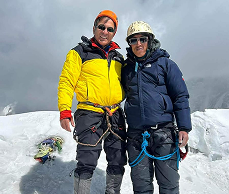


Safety, Equipment, and High-Alpine Protocols
Operating a technical 6,000-meter peak requires flawless safety standards. Our Lobuche East operations are designed around strict risk-mitigation protocols to protect every climber.
Maximum Acclimatization via Everest Base Camp
We do not rush the climb. Our itinerary includes two dedicated acclimatization rest days (at Namche and Dingboche) and climbs all the way to Everest Base Camp (5,364m) and Kala Patthar (5,550m) before we even touch the base of Lobuche East. This extensive high-altitude exposure ensures your body is fully adapted to the thin air, dramatically increasing your safety and summit success rate.
Mandatory Glacier & Fixed-Line Training
On Day 11 at High Camp, our climbing Sherpas set up an active vertical training line on a nearby ice slope. Every client is required to practice ascending with a Jumar, transitioning at rope anchors, and rappelling safely with a descender. You will not be permitted to attempt the summit push until our lead guide passes your safety handling check.
Elite Guide-to-Client Ratios
Because Lobuche East features exposed, technical sections where active monitoring is critical, we operate with an elite 1:2 guide-to-client ratio on summit day. For larger groups, an extra dedicated climbing Sherpa is assigned to manage rope anchors and provide 1-on-1 physical anchoring security on the knife-edge summit ridge.
Advanced Medical Kits & Emergency Evacuation
Our team carries comprehensive high-altitude trauma kits, pulse oximeters to monitor blood-oxygen saturation levels daily, and emergency supplemental oxygen cylinders at High Camp. In the event of severe Acute Mountain Sickness (AMS) or an alpine injury, we maintain direct satellite communication channels to trigger an immediate high-altitude helicopter medical evacuation directly from the Lobuche base or lower camps back to top-tier hospitals in Kathmandu.
Buffer Days: Always factor 2 extra cushion days into your overall travel itinerary. Lukla flights are frequently delayed or completely canceled due to sudden cloud cover, fog, or high winds.
Ramechhap (Manthali) Airport: During peak trekking seasons (Spring and Autumn), flights frequently divert out of Manthali Airport (a 4 to 5-hour drive from Kathmandu) instead of Kathmandu Airport to avoid domestic runway traffic.

Didn’t find what you were looking for?
So why not plan your own trip. It takes only 2 minutes.

 18 Days
.svg) 6,189m/20,305ft
6,189m/20,305ft

